Music was already part of our lives long before it had a corner of its own. My boyfriend is most at home in blues rock; I have a particular obsession with art rock. Somewhere between those two worlds, between the immediacy of a guitar and the strange architecture of an album that refuses to reveal itself all at once, we meet.
Our tastes overlap far more often than they differ. Jazz, blues, trip-hop, ambient, classic rock, post-rock and experimental music all find their way into the room. What matters most to us is not staying faithful to one genre, but finding music with character: music that has been composed, performed and produced with enough care to reward attention.
Eventually, listening through whatever device happened to be nearby no longer felt like quite enough. We wanted to give music a physical place in our home.
Music first, equipment second
There is a version of audiophilia that can appear to be mostly about specifications, increasingly expensive equipment and the pursuit of a theoretically perfect sound. That was never what attracted us.
We are music-first audiophiles. The equipment matters because the music matters.
We wanted a system that could bring detail, warmth and presence into the room without turning listening into a technical exercise. It needed to sound good, naturally, but it also needed to belong in our home. This would not be a sealed listening laboratory with a single chair positioned at a mathematically perfect angle. It would be part of the life happening around it.
Sometimes we sit down specifically to listen. Sometimes a record plays while we cook. When friends come over for dinner or board games, we let the system sing quietly in the background, changing the atmosphere of the room without demanding its full attention. On slower evenings, the music becomes the occasion itself.
The corner had to work for all of those versions of listening.
Building the corner
We approached the equipment carefully. We spent time reading audiophile communities—especially discussions on Reddit—and comparing advice from websites dedicated to hi-fi equipment. We were looking for strong price-to-performance rather than prestige: components that were well regarded for what they cost and made sense together.
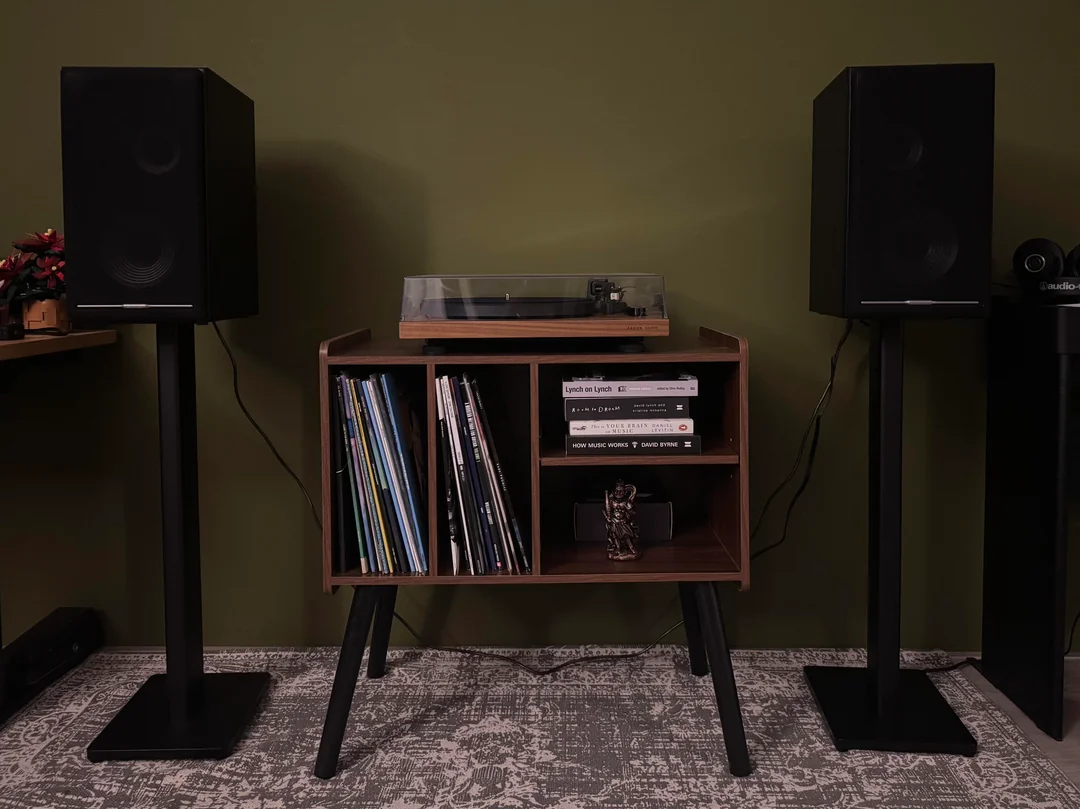
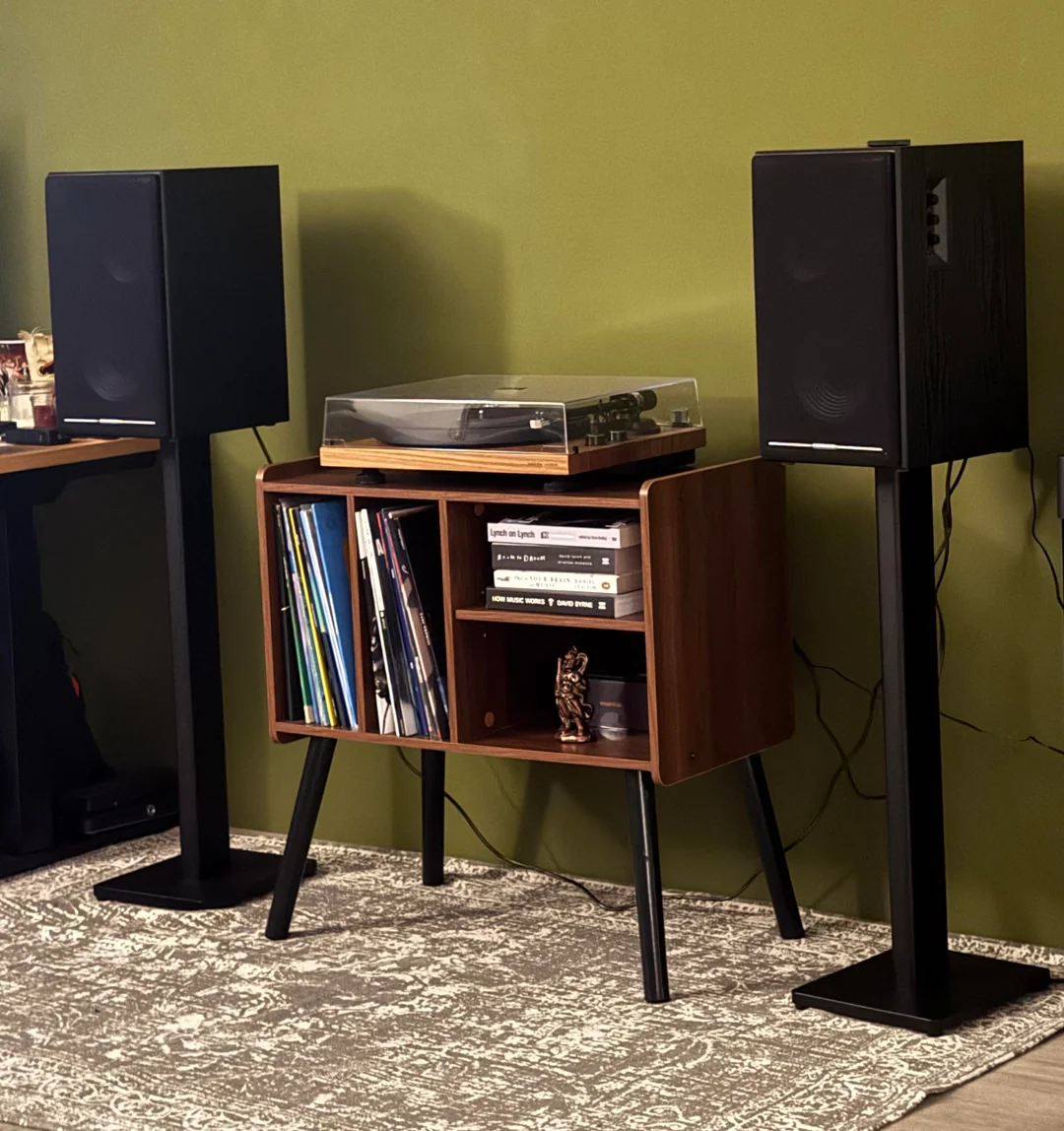
We eventually chose an Argon Audio TT Mk2 turntable and Edifier R2750DB active speakers. Active speakers allowed us to create a capable and relatively straightforward system without immediately adding a separate amplifier and another layer of equipment.
Appearance mattered too. We deliberately looked for wooden finishes and materials that would make the setup feel warm and settled rather than overly technical. The turntable now rests on a wooden cabinet between the two speakers, surrounded by records, books and a few objects we wanted to live alongside the music.
The olive-green wall, dark speakers and walnut tones turned it into something more inviting than a collection of electronics. It became part listening space, part library and part portrait of our shared taste.
Two tastes meeting in one room
His centre of gravity is blues rock. Mine is art rock and symphonic progressive rock.
That means Jimi Hendrix and Stevie Ray Vaughan sit naturally beside David Bowie, King Crimson, Yes, Genesis and Pink Floyd. From there, the collection moves outward: into the nocturnal world of Portishead and Massive Attack, the spaciousness of jazz, the intimacy of Leonard Cohen and Sade, and records that are more difficult to classify neatly.
Art rock remains the thread I follow most obsessively. I love albums that treat the studio as part of the composition, records built not only from melody and performance, but from texture, sequencing, atmosphere and ideas. They invite you to return because they never seem completely finished with you.
Blues rock offers a different kind of intensity: the physical character of the guitar, the personality contained in a particular tone and the feeling that a performance is unfolding directly in front of you. Between these two preferences, we have found a shared listening world that can be intricate without becoming cold and expressive without becoming predictable.
The system gives both sides room.
A collection built deliberately, and by chance
Our first group of records from North End Haarlem created a remarkably accurate outline of our taste:
Jimi Hendrix — Are You Experienced
Portishead — Dummy
Massive Attack — Mezzanine
Dire Straits — Brothers in Arms
John Coltrane — A Love Supreme
Pink Floyd — The Dark Side of the Moon
Even within those six albums, there are several different ideas about what good listening can be: raw guitar, carefully constructed atmosphere, studio precision, improvisation and the scale of an album conceived as a complete work.
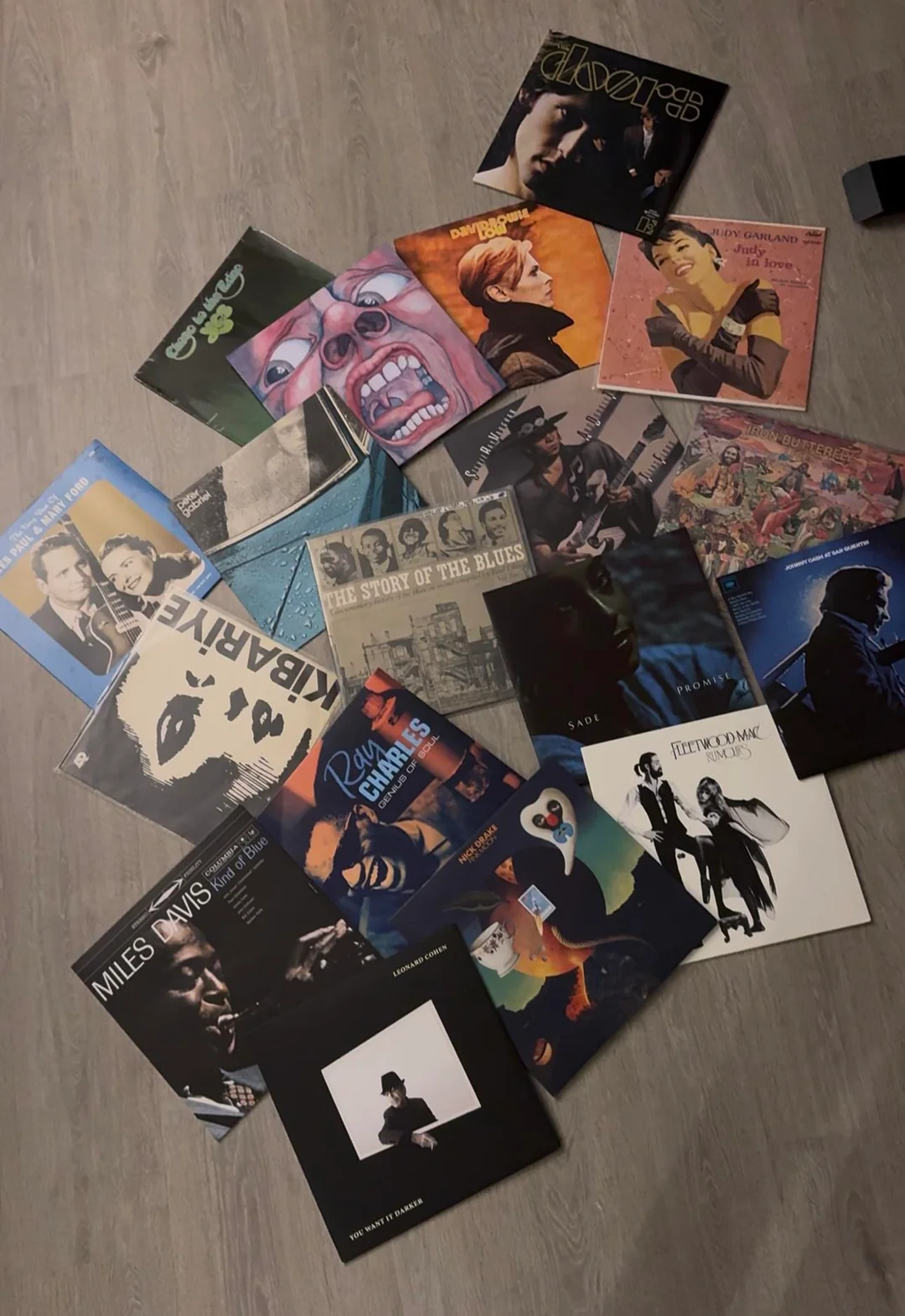
Other records entered the collection through the Record & CD Fair at RAI Amsterdam in January. Buying online is useful when you already know exactly what you want, but a record fair offers something different. You move between tables without knowing what will interrupt your attention. Familiar artwork appears among records you have never seen before, and an album can find its way home through recognition, curiosity or simple chance.
The collection now includes music by Bowie, King Crimson, Miles Davis, Björk, Judy Garland, Fleetwood Mac, Leonard Cohen, Sade, Ray Charles, The Doors and others. It is still small enough for every addition to feel visible. We are not trying to fill the shelves as quickly as possible; we want the collection to grow around music we genuinely want to return to.
We are already looking forward to the Mega Record & CD Fair at the Brabanthallen in Den Bosch this November. Part of the pleasure is knowing that the collection is unfinished, and that we cannot predict everything that will be added next.
Between vinyl and digital
Loving vinyl has not made us hostile to digital listening. The two formats occupy different parts of our musical life.
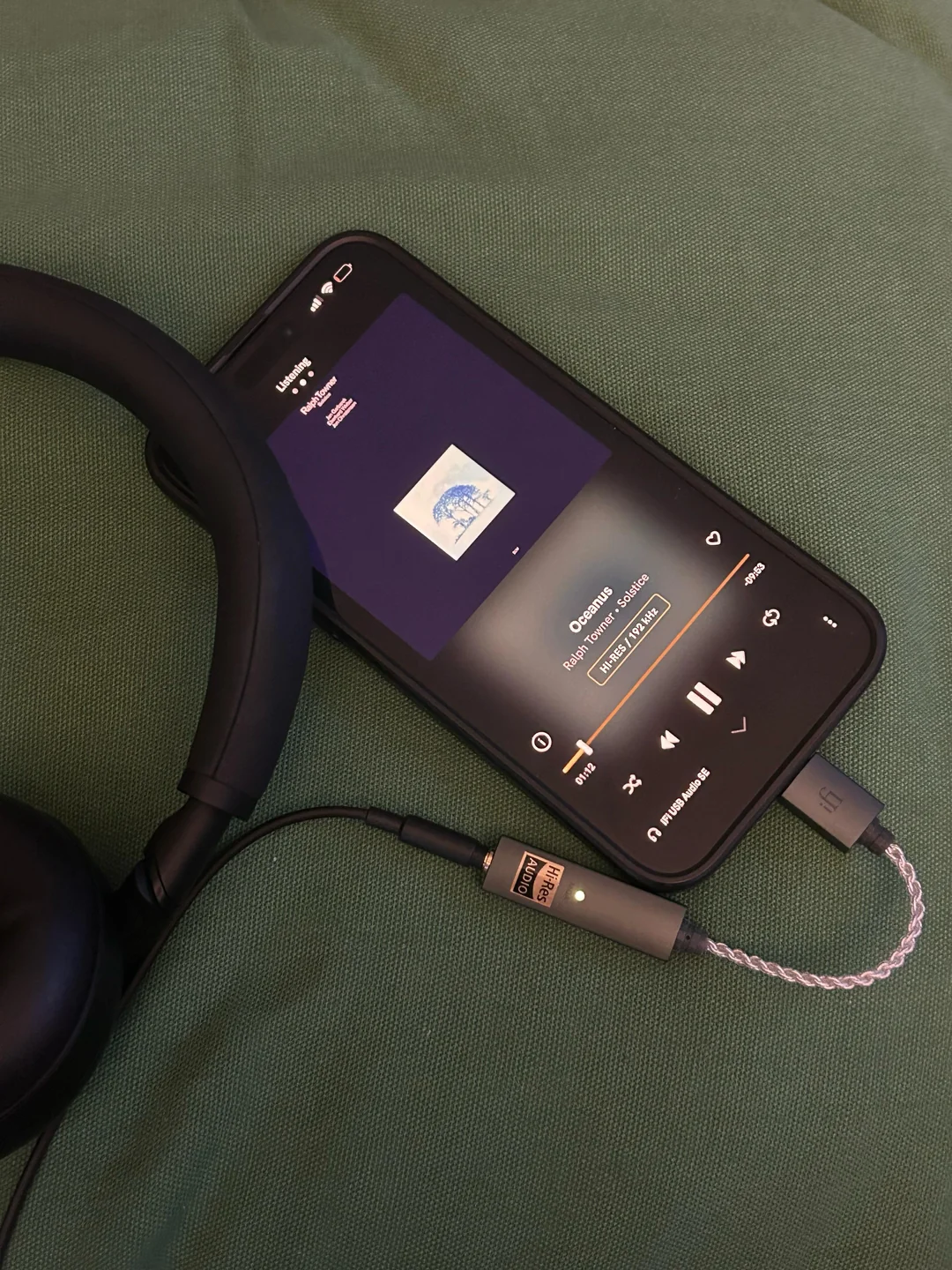
For everyday listening and discovery, we mostly use Spotify Lossless. When a favourite album is available in 24-bit/96 kHz or higher and feels worth owning digitally, we may also buy it through Qobuz.
Digital listening gives us breadth and immediacy. It lets one album lead into another without requiring every curiosity to become a physical purchase. Vinyl creates a different relationship with the album. Choosing something from the shelf, removing it from its sleeve and turning it over halfway through introduces a small amount of ceremony. It asks for a decision.
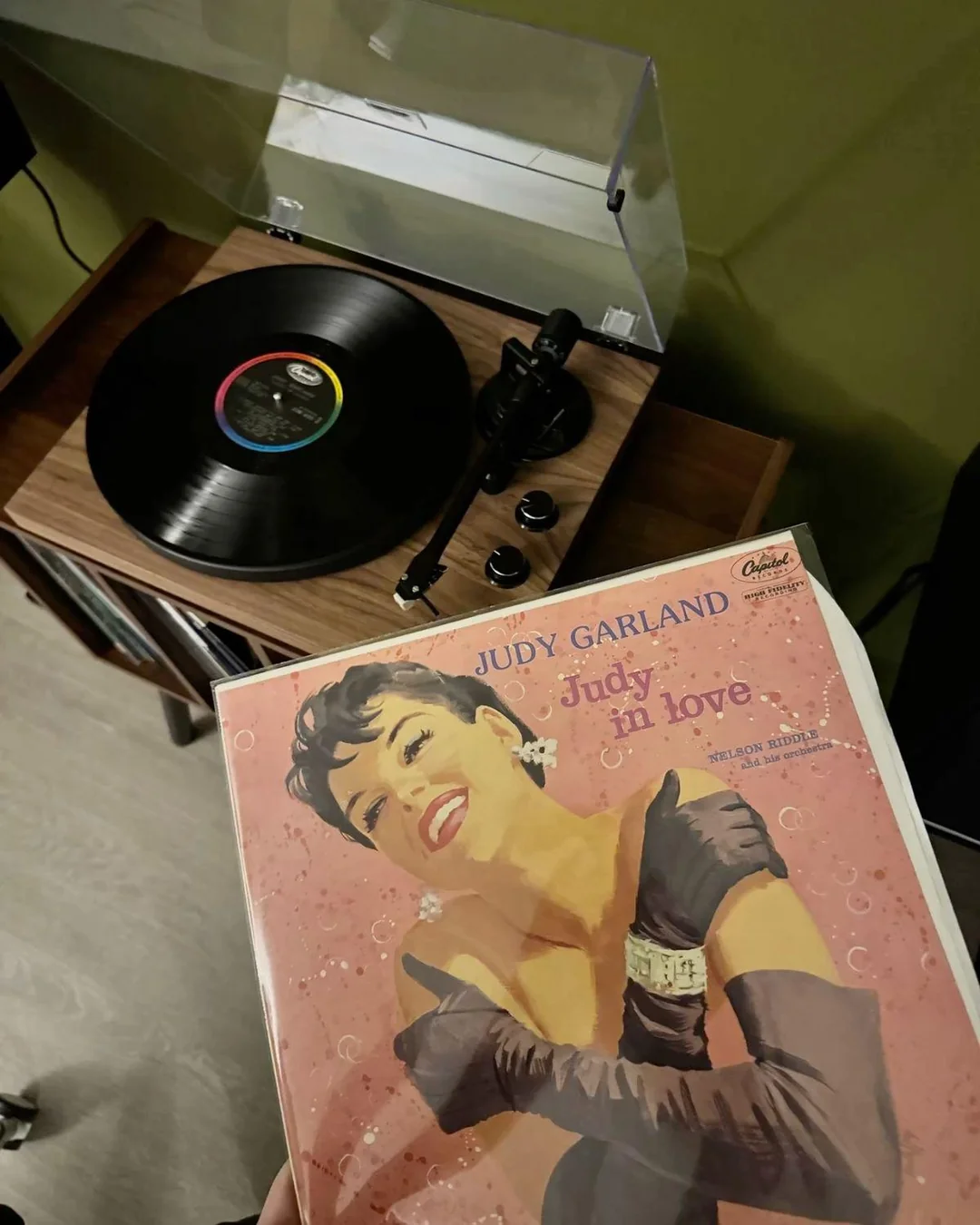
Neither experience cancels the other. One allows us to explore widely; the other encourages us to stay.
A system still becoming
This is not our final system, if such a thing exists. We are still learning about speaker placement, the room itself and which future improvement would make the most meaningful difference. That uncertainty is part of the appeal.
Audiophile communities gave us a useful starting point, but the room will ultimately teach us more than a specification sheet can. Every adjustment has to make sense not only from the ideal listening position, but during dinner, while cooking and when friends are gathered around a board game.
For now, the corner already does what we wanted it to do. It gives albums a place to be heard properly. It lets our different musical instincts meet without asking either of us to surrender them. Most importantly, it makes music part of the atmosphere of our home, not as decoration, but as a living presence within it.
The shelves will grow. The equipment may change. Our ideas about good sound will probably become more particular with time.
But the purpose of the corner is already settled: to make space for listening, together.
Until next time,
Suhe